
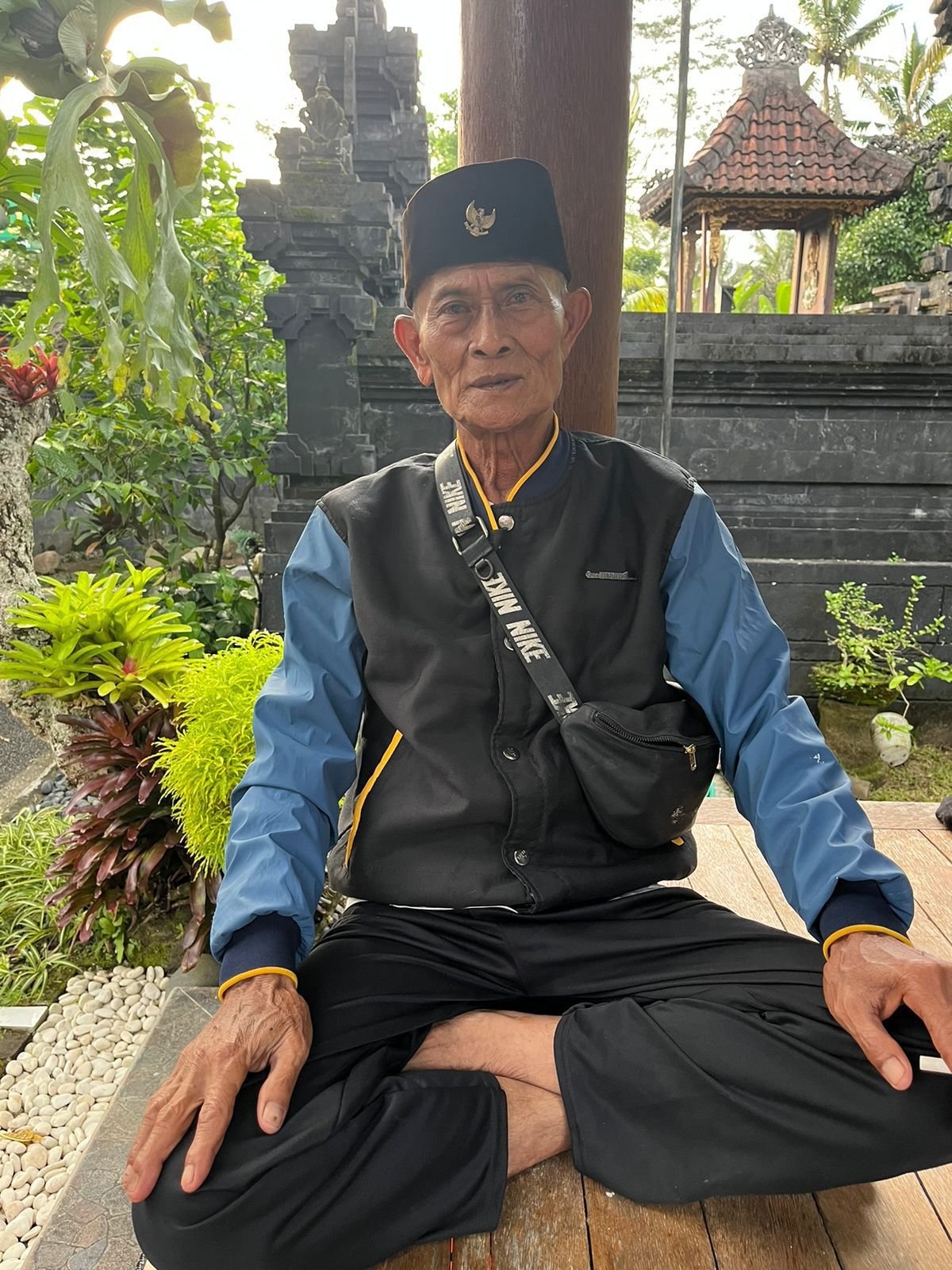
Sacred Fire in the Open Heavens: Walking an Elder Home
I heard a familiar ping of an incoming message. Still in bed, eyes barely open, still sealed with eye crust,I assumed it was my Sister, Cheryl. She is normally the first to contact me, in the morning.
As I reached for my phone, I was surprised to see my friend and community neighbor Ketut’s name pop up. A sudden uneasiness fell over me. The message was simple.
But it wasn’t.
“Good Morning, Amy.” (8:52am) Then a second ping.
“I’m sorry I couldn’t come yesterday personally.” (8:54)
The words were fine. But they sounded pre-emptive to me. And the time was off. There is an unwritten rule in this community, that if a person is not out and visible, not to disturb them until 10am. Ketut never communicated this early. And before I could fully process that thought, the phone rang. It was Ketut.
His voice sounded friendly, but heavy.
Hello, Amy. How was your Birthday? (My Birthday was the day prior, and Ketut had sent over a platter of food called Nasi Tumpeng (TUM’ Peng))
I told him the gathering was enjoyable. It is fascinating how many questions the brain can generate in a matter of sheer seconds.
He apologized, again, for personally not delivering the platter. I told him tidak papa (No problem)
Before I could get the words out, “Is anything wrong?” He says to me… “I didn’t tell you yesterday, because I didn’t want to ruin your day, but my Father died.” I can now hear the tone in his voice shifting from formalities to grief.
Ketut…I am so sorry.
While I only met his Father once, Ketut spoke often of him. In recent months, he had been in the hospital with liver failure. I felt his pain come through the phone like a bolt of lightning.
“I wanted to know if you wanted to come to his cremation ceremony tomorrow?”
There is a benefit in messaging someone versus an actual phone conversation. You don’t have the luxury of time, in a real-time conversation, to get your words together and plan eloquent responses.
“Yes. Of course” It was all I could muster. He said if I had existing plans, he understood. And I did, but they greatly paled in importance compared to seeing his Father off in a traditional Balinese cremation. I assured him, (without knowing any of the details) that I would be there. As someone who rarely is without a response or rebuttal, I found myself grasping for words to properly convey the hug I was sending him in my heart. He told me that Dewa, his Father In Law, and the head of this lovely family would come by to pick me up at 8:30am the following morning.
Within an hour, I saw Dewa outside, tending to my yard. (The villa that I rent is on their family land) I raced outside, eager to ask him all of the questions that were not appropriate to ask Ketut.
It was clear very quickly that Dewa did not know he was taking me to the ceremony. Nevertheless I informed him of Ketut’s words. It humbled me that he asked what time I would like him to come pick me up. This is a brilliant example of Balinese hospitality: they are always prioritizing the comfort of their guests.
I shifted his thinking immediately. No I told him I will be ready when you get here. I just need to know what time. He suggested 8:30 AM. I told him that was perfect.
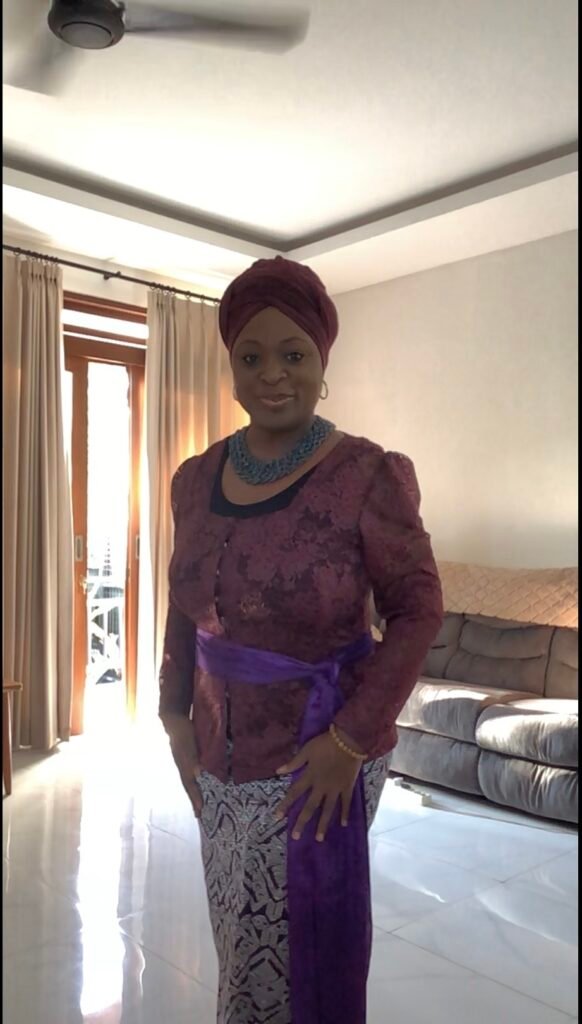
I then asked him what I should wear. I could see him hesitating so I asked directly if I should wear my traditional Balinese attire. His face lit up with a look of surprise and pleasure. He asked me if I already owned traditional clothing. I was proud to say that I did.
Because Dewa’s English is still a work in process just like my Indonesian he asked me twice more if I really had the clothes. He did not want me to go out and buy something new just for this ceremony and he insisted I could wear whatever was comfortable. I assured him not only that I already owned it but that I would be fully dressed and ready at 8:30 AM.
One final question remained. I needed to know what I should bring. He began to hesitate again not wanting to impose on me. He started to give me a general and polite answer about how nothing was really necessary.
I interrupted his politeness with a direct question. What is Jhero Madé (his wife) bringing?
He smiled pleasantly caught in my line of questioning. Madé is bringing chicken he responded. He followed up by saying that while anything is appreciated nothing is strictly required.
Very well then!
I came inside and called Madé my house manager and now friend. She is the person who took me shopping months ago to help me find proper Balinese attire for ceremonies. I asked her to stop by on her way out today and she arrived moments later.
I told her what had transpired and her face immediately shifted from friendly to serious. She understood exactly why I needed her. She helped me assemble the right components and colors for the following day’s ceremony. This is why she is so much more than a housekeeper to me.
I asked her where I could purchase a chicken to take the next day. The logistics seemed cumbersome to me. She looked at me and said Ibu (EE boo) perhaps it is better to give a financial gift instead.
That suggestion sat just fine with me. I asked her what was appropriate for this type of event and she gave me two options: one modest and one generous. She explained the reasoning behind each choice.
She explained that the direct invitation early in the morning along with the delivery of the birthday food the day before and the constant attention to my home all pointed toward one thing. They have accepted me as family. She verbalized and confirmed exactly what I felt in my heart.
Over the next twenty four hours the plans changed. The humidity was forecast to have Sayan feeling like 101 degrees so the outdoor ceremony was moved up to 8:00 AM.
Dewa was needed much earlier than that for preparations. Because of this his son in law also named Dewa came to get me at 7:30 AM. Dewa #2 is young and communicative and funny and smart. He drove me in his father in law’s car for about thirty minutes to a place called Sangeh (SAH nggay). This is Ketut’s home town.
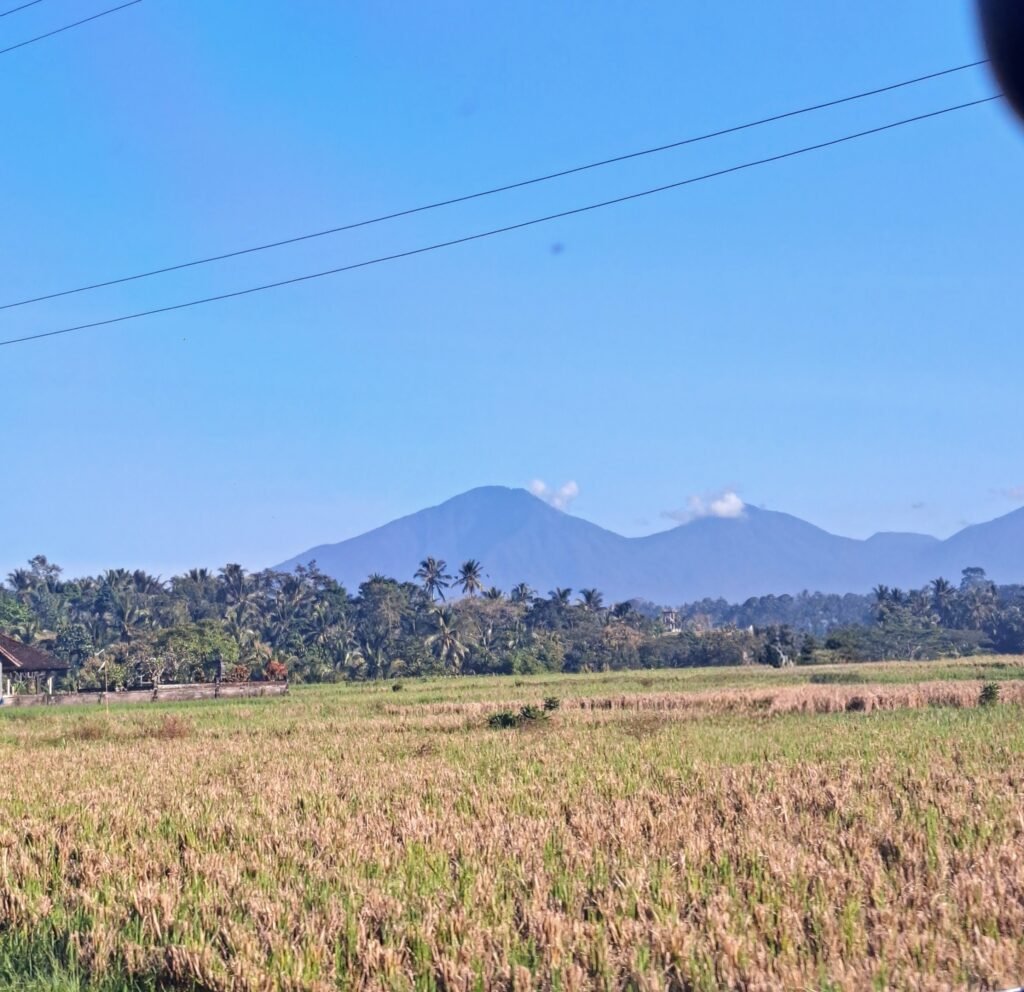
The drive was lovely but my questions were mounting. I wanted to know what to expect and what the procedure was and how many people would be there. Dewa #2 was the perfect companion for that day. He was patient and explained much about the culture and the process.
His wife Adelia recently had a baby so she stayed home with the infant. She had asked me to accompany him which added another layer of familial connection to the morning journey.
Once we arrived, we parked and walked a short distance. Seated on the ground were a group of elders. This was just the first of many curious stares that I would receive that day. I nodded as they stared. Some smiled and some nodded back with unspoken questions on their faces.
I took a deep breath as we walked into the vast courtyard of a traditional Balinese style home. There must have been almost one hundred people present. My eyes could not scan the crowd and navigate my steps at the same time. Dewa #2 told me that Ketut was around somewhere and that I should make myself at home before he started to walk off.
Not so fast homeboy, I thought, as I mentally pulled him back toward me. I told him he should help me find Ketut first. I may have perfected the look of confidence over the years but that is just a look. At this moment I was feeling quite out of place and to be honest I felt a bit nervous. Probably fear of the unknown.
Dewa #2 complied with a delayed smile of acknowledgement. Soon after, I saw Jhero Madé and Ariska and Dewa #1 along with other familiar faces. They welcomed me with hugs and some with a rather specific gesture.
This gesture, where some took my hand and placed it on their forehead or cheek is called a Salim (sah LEEM). I understand now that it is a declaration of respect and honor and hierarchy.
It is a way of acknowledging that the recipient is an elder or a teacher or a person of higher social or spiritual standing. It is also a request for a blessing where the younger person symbolically inhales the wisdom or grace of the elder. Finally it is a signal that the person performing the gesture is grateful for your presence. Knowing this now makes those greetings even more gracious than they felt in the moment.
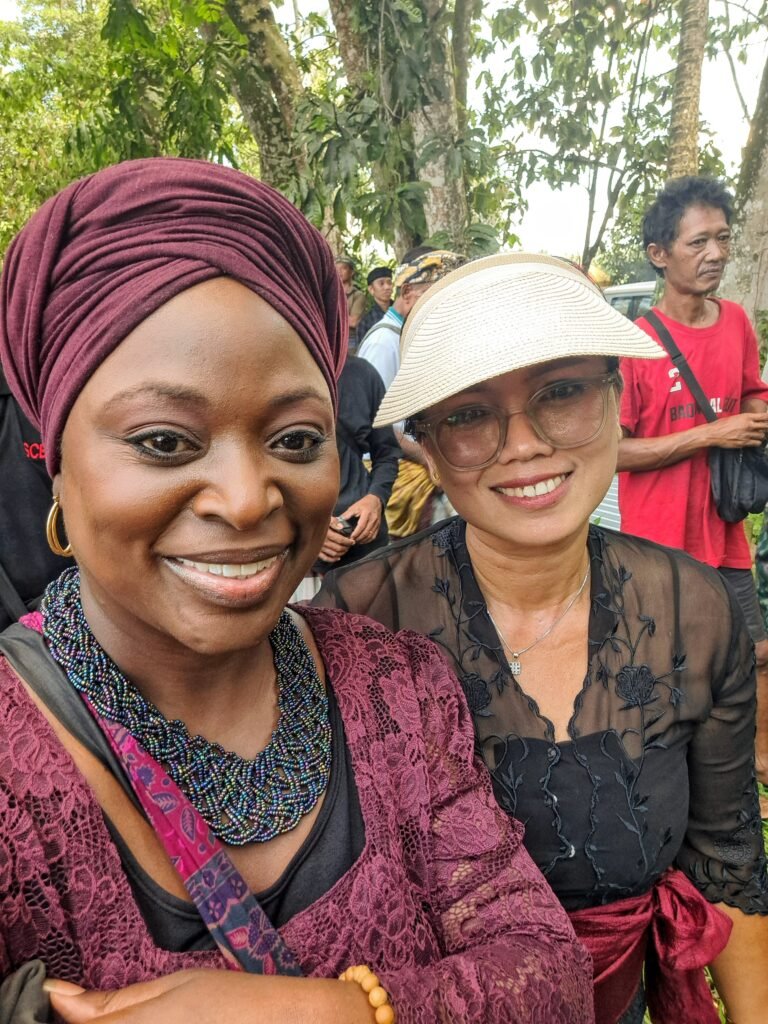
Ketut seemed so excited to see me. Amy, (“Ahh-MEE,” in Indonesian) you look great! This was the first thing he said, and while I do not dress for men, it did my heart well to get his approval of my attire for his Father’s cremation.
He immediately began taking me around and introducing me to everyone! This is Ahh-Mee. She is part of our family. He said this so many times to cousins, uncles, in-laws, and guests, that I began saying it, myself. My name is Ahh-Mee and I am part of the family!! 😆
Soon after, Ketut came to me and asked me if I’d like to come “witness the ceremony.” I didn’t know what this entails, but I said a gracious yes. He walked me to the outer edge of a circle of men surrounding a platform. A group of elders brought out something wrapped in linens, which my mind said was way to small to be a human male. But to my dismay, as they unwrapped the package, it was indeed a human male, Ketut’s father. His body, void of life just over 48 hours was dark and sunken in. He resembled a skeleton or an ancient egyptian mummy, unwrapped. Like most of you, I have seen a deceased person before. I’ve seen one at the time of death and I’ve seen many in an embalmed state. But, I had never witnessed a body in a decay state. Although we all know he was no longer there, and no longer in pain, seeing the reminder of his Earthly vessel was painful.
I feel I have no right to use the word painful in relation to how I felt. For, it was Ketut, who led this circle of men in anointing father’s body with salt. He kept a small rag over his father’s dignity, during the service. Then the men washed the body with water, removing all of the salt. After that, they completely dried him off with towels and dressed him in the finest of outfits. I don’t know how Ketut did it. In America, many of us can barely withstand our loved one’s homegoing service, let alone to prepare the body.
About an hour later there was praying and laughing and much fellowship. Dewa #2 stayed nearby. Eventually it was time to eat.
As most of you know I have an extremely sensitive stomach. I did not want to eat a single thing.
No new dishes. No spicy foods. No unknown ingredients.
But this moment was about more than my comfort. I had met so many people who seemed to take a liking to me. Kadek (KAH dek) a fifty-something year old cousin kept me in entertaining conversation. She reminds me of an Indonesian version of Monique, the comedian/actress. She was outspoken, assertive, confident and witty. She clearly did not take any mess from anyone.
She, like the others wanted to make sure I ate. I was not about to argue with her. I got in the food line and took minimal portions of the few things I recognized.
As Kadek and Dewa #2 and myself were returning to our seats I saw Ketut from all the way across the courtyard. He was yelling to someone in the kitchen. I could not translate the words with my limited Indonesian.
Seconds later a woman placed a spoon on my bamboo plate. I thanked her, but as I looked around I noticed something startling. I was the only person in this entire gathering with a spoon. Everyone else was eating with their fingers.
This is another illustration of Balinese hospitality. Can you imagine the depth of that concern. You have just spent your morning cleaning and dressing your father’s corpse publicly. Yet instead of sitting in that grief you are concerned about whether your American friend has utensils.
I felt loved and honored. But I also felt my spirit of rebellion come fully to the surface.
I ignored the spoon as if she were an unwanted guest.
I ate my food with my fingers.
Proudly.
Defiantly.
About an hour after that, we walked from the family home to the cremation site. The heartbeat of the ceremony lived within the drums and singing. These two headed instruments known as the Kendang (ken DAHNG) acted as the conductor for the entire event. The players sat at the center of the ensemble, called a Gamelan (GAH meh lahn) and dictated the pace of the transition with every strike. Their hands moved with a rhythmic certainty that mirrored the heavy steps of the men and women walking to the cremation site. It was a language of sound that connected the earth to the sky.
Interwoven with that rhythm was the collective voice of the men. They began to sing in a chant that felt more like a spiritual than a formal prayer. Even though I could not translate exactly what they were singing, the frequency was hauntingly familiar. It carried the same resonance as the songs heard at home during the funerals of elders in North Carolina. It was the sound of a community leaning into their faith to carry the weight of a loss. In that moment, the distance between the South of the US and Bali dissolved. I realized that the language of grief and the language of hope are universal. You do not need to understand the lyrics when the soul is doing the talking.
Cremations in Indonesia are expensive and so often, they are combined. There was another family, within the same community saying good bye to a loved one. As we waited for them to gather their loved one at the cremation site. Ketut’s father was carried on a Bade. (Bah-day) A bade is a manmade wooden structure that the Balinese people use to transport the body. Think hearse. Except this hearse is made of bamboo and carried on the shoulders of men. In Indonesia, they view it as the vehicle that carries the soul to the heavens. The men were literally walking the Elder home, to his final resting place.
Once at the cremation site, there was more praying, some words were said and then Ketut, who seemed visibly exhausted to me, said his final public goodbyes and a massive gas-propelled fire was set over both coffins. It was at this time that I looked at Dewa #2. He looked at me. We gave each other an unspoken signal and quietly made our exit. It was after 2pm at this point. It had been a long day, full of emotion, fellowship, fear, new acquaintances, conversation limited by language but joined by common emotions.
Although the remaining parts of the ceremony went on into the late parts of the night, Dewa #2 and I left. Ketut insisted that since I was in Sangeh, that Dewa #2 take me to the Monkey Park. (Not to be confused with the aggressive monkeys in Ubud) It was the perfect way to end the day on a lighter note. Against everything in my cultural common sense, I fed the monkeys peanuts. They were gentle and playful. It’s almost as if they sensed I had been through enough that day. So, they gave me a break.
As Dewa #2 finally drove me home, I had plenty of time to think about the profound weight of a culture that understands the math of the soul. Here, as in the US, death is not a solitary walk but a communal heave. It is a lifting of the spirit by the hands and voices of the many. I stood in the balance of opposites, listening to the Gamelan and the singing that felt so much like the spirituals of my own people. The same fire that signaled an ending was the catalyst for a spiritual beginning. To be invited into that sacred heat, only to find myself hours later laughing at the playful monkeys, was a lesson in pure gratitude. It was a reminder that while the body may return to the earth as ash, the community remains. Whether in a church in the South or a temple in Sangeh, we are all just walking each other home through the music and the flame.
I took one step closer to my version of freedom. What does freedom look like for you?
[working_comments]

Test Comment!
So sorry for the loss. I felt that and l only imagine the heartfelt experience.
Yes, Ma’am. It was a really a sacred and sad, but beautiful event.❤️🩹